Beskrivning
Visa orginaltexten
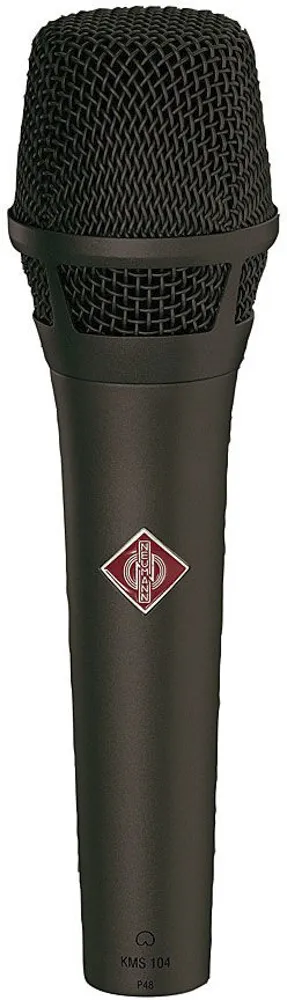
Mikrofonerna KMS 104/104 plus och KMS 105 har utvecklats för att optimalt överföra den mänskliga rösten med hänsyn till de krävande förhållanden som finns på livescenen.
KMS-serien har blivit den internationellt erkända standarden för förstklassiga scenmikrofoner.
Mikrofonernas höga akustiska upplösning och mjuka frekvensrespons säkerställer att musikern har optimal kontroll över scenframträdandet hela tiden.
Speciellt på grund av deras låga självbrus och överhörningsbeteende som är fritt från färg, är KMS-mikrofonerna idealiska för användning med in-ear monitoring system.
KMS 104 och KMS 104 plus har en kondensatormikrofonkapsel med en kardioid riktningskaraktäristik som ger bästa möjliga dämpning av ljud som kommer från bakom mikrofonen. Däremot är KMS 105 med sina superkardioida egenskaper särskilt bra på att undertrycka ljud som kommer från hela 180°-halvklotet bakom mikrofonen. KMS 104 plus har, jämfört med KMS 104, en mer utökad basfrekvensrespons. I nära samarbete med professionella musiker, med hjälp av omfattande praktiska tester, har KMS 104 plus optimerats speciellt för kraven på kvinnliga röster inom rock- och popområdet.
Användaren kan alltså välja den version som är optimalt lämpad för den specifika applikationen.
Akustiska egenskaper
Studiokondensatorkapslarna som används i mikrofonversionerna utgör grunden för att överföra alla nyanser av den mänskliga rösten. Jämfört med andra handhållna mikrofoner, som mest fungerar med dynamiska kapslar, har KMS-serien en särskilt hög akustisk transparens, ett brett frekvensområde och en fin upplösning av transienter.
I KMS-mikrofoner förhindrar noggrant justerade akustiska filter och transformatorlösa impedansomvandlare som klarar mycket höga ljudtrycksnivåer att mikrofonerna överbelastas även av starka plosiva ljud.
Trots utmärkt popskydd sänds sibilanter och ”S”-ljud med sin naturliga accentuering, vilket bara är möjligt med kondensatormikrofoner. Dessutom är de ovan nämnda akustiska filtren utformade så att kapslarnas distinkta riktningsegenskaper bevaras även i basområdet. Filtren säkerställer därmed en mycket hög nivå av återkopplingsskydd för sångmikrofonerna KMS 104/104 plus och KMS 105 när de används med ett scenljudssystem.
Elektriska funktioner
Eftersom sångmikrofoner vanligtvis adresseras på nära håll, används elektronisk kompensation för närhetseffekten i respektive kapslar för basfrekvensresponsen hos mikrofonerna.
Dessutom har mikrofonen ett oföränderligt, inbyggt högpassfilter med en gränsfrekvens på 120 Hz (–3 dB, mätt i ett fritt ljudfält). Den maximala ljudtrycksnivån för KMS-mikrofonerna är 150 dB.
Den låga självbrusnivån på endast 18 dB A gör att mikrofonerna kan användas med höga förstärkningsnivåer utan risk för extra brus. Även på stora avstånd arbetar mikrofonerna således med ett högt signal-brusförhållande, vilket underlättar rörelsefriheten och kreativiteten som är viktiga för konstnären.
Tack vare den transformatorlösa utgångskretsen kan mikrofonsignalerna överföras även genom långa kablar utan ljudförlust.
Mekaniska egenskaper
Mikrofoner designade för användning på scen kräver en särskilt robust konstruktion. KMS 104/104 plus och KMS 105 har därför tjockväggiga metallhöljen, som även ger ett effektivt skydd mot hanteringsljud.
Mikrofongallerna är gjorda av härdat stål. Vid behov kan de enkelt skruvas loss för att möjliggöra rengöring av de inre akustikfiltren.
Leveransintervall
Mikrofonerna KMS 104/104 plus och KMS 105, med en matchande stativklämma, levereras i en snygg vadderad nylonväska som är tillräckligt hållbar för turné.
Akustisk funktionsprincip Tryckgradientgivare
Riktningsmönster Kardioid/kardioid/superkardioid
Frekvensområde 20 Hz … 20 kHz
Känslighet vid 1 kHz till 1 kohm 4,5 mV/Pa
Märkimpedans 50 ohm
Nominell belastningsimpedans 1 kohm
Ekvivalent ljudnivå, CCIR1) 28 dB
Ekvivalent ljudnivå, A-vägd1) 18 dB-A
Signal-brusförhållande, CCIR1) (rel. 94 dB SPL) 66 dB
Signal-brusförhållande, A-vägd1) (rel. 94 dB SPL) 76 dB
Maximal SPL för THD 0,5%2) 150 dB
Max utspänning 12 dBu
Matningsspänning (P48, IEC 1938) 48 V ± 4 V
Strömförbrukning (P48, IEC 1938) 3,5 mA
Matchande kontakt XLR3F
Vikt ca. 300 g
Diameter 48 mm
Längd 180 mm
Visa översättning
The KMS 104/104 plus and the KMS 105 microphones have been developed to optimally transmit the human voice with respect to the demanding conditions present on the live stage.
The KMS series has become the internationally acknowledged standard for first-class stage microphones.
The high acoustic resolution and smooth frequency response of the microphones ensure that the musician has optimal control of the stage performance at all times.
Especially due to their low self-noise and crosstalk behavior which is free of coloration, the KMS microphones are ideal for use with in-ear monitoring systems.
The KMS 104 and the KMS 104 plus have a condenser microphone capsule with a cardioid directional characteristic which provides the best possible suppression of sounds originating from behind the microphone. In contrast, with its supercardioid characteristic the KMS 105 is particularly good at suppressing sounds originating from the entire 180° hemisphere behind the microphone. The KMS 104 plus features, compared to KMS 104, a more extended bass frequency response. In close cooperation with professional musicians, with the aid of extensive practical tests, the KMS 104 plus has been especially optimized for the requirements of female voices in the rock and pop field.
The user can thus select the version that is optimally suited to the specific application.
Acoustic features
The studio condenser capsules used in the microphone versions provide the basis for transmitting all the nuances of the human voice. In comparison with other handheld microphones, which operate mostly with dynamic capsules, the KMS series has a particularly high acoustic transparency, a wide frequency range and a fine resolution of transients.
In KMS microphones, carefully adjusted acoustic filters and transformerless impedance converters that can handle very high sound pressure levels prevent the microphones from being overloaded even by strong plosive sounds.
In spite of excellent pop protection, sibilants and “S” sounds are transmitted with their natural accentuation, as is possible only with condenser microphones. Furthermore, the above-mentioned acoustic filters are designed so that the distinctive directional characteristics of the capsules are preserved even in the bass range. The filters thus ensure a very high level of feedback protection for the KMS 104/104 plus and KMS 105 vocal microphones when they are used with a stage sound system.
Electrical features
Since vocal microphones are typically addressed at close range, for the bass frequency response of the microphones, electronic compensation is used for the proximity effect in the respective capsules.
In addition, the microphone has an invariable, built-in high-pass filter with a cutoff frequency of 120 Hz (–3 dB, measured in a free sound field). The maximum sound pressure level of the KMS microphones is 150 dB.
The low self-noise level of only 18 dB A permits the microphones to be used at high gain levels without the risk of additional noise. Even at large distances, the microphones thus operate with a high signal-to-noise ratio, facilitating the freedom of movement and creativity that are important to the artist.
Due to the transformerless output circuit, the microphone signals can be transmitted even through long cables without loss of sound.
Mechanical features
Microphones designed for use on stage require a particularly robust construction. The KMS 104/104 plus and KMS 105 therefore have thick-walled metal housings, which also provide effective protection against handling noise.
The microphone headgrilles are made of hardened steel. If required, they can easily be unscrewed to permit cleaning of the interior acoustic filters.
Delivery Range
The KMS 104/104 plus and KMS 105 microphones, with a matching stand clamp, are supplied in an attractive padded nylon bag that is sufficiently durable for touring.
Acoustical operating principle Pressure gradient transducer
Directional pattern Cardioid/cardioid/supercardioid
Frequency range 20 Hz … 20 kHz
Sensitivity at 1 kHz into 1 kohm 4.5 mV/Pa
Rated impedance 50 ohms
Rated load impedance 1 kohms
Equivalent noise level, CCIR1) 28 dB
Equivalent noise level, A-weighted1) 18 dB-A
Signal-to-noise ratio, CCIR1) (rel. 94 dB SPL) 66 dB
Signal-to-noise ratio, A-weighted1) (rel. 94 dB SPL) 76 dB
Maximum SPL for THD 0.5%2) 150 dB
Maximum output voltage 12 dBu
Supply voltage (P48, IEC 1938) 48 V ± 4 V
Current consumption (P48, IEC 1938) 3.5 mA
Matching connector XLR3F
Weight approx. 300 g
Diameter 48 mm
Length 180 mm